Linear Was Never the Cable Box
Continuous. Lean-back. Zero-click. Programmed-by-someone-else. Those are the four traits that defined linear television in 1995 — and the four traits the YouTube CTV home delivers in 2026. The cable box was never the product. The couch was.
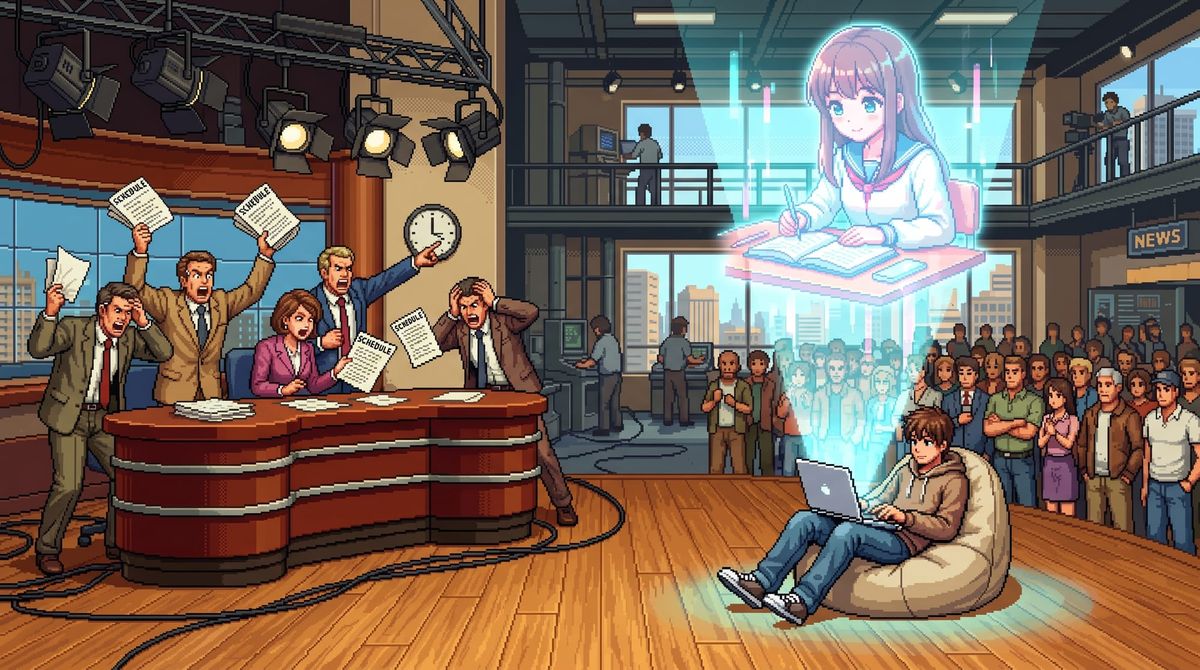
Strip "linear" down to first principles and the cable box turns out to be the annoying part, not the appealing part. The actual psychological product — continuous, lean-back, zero-click, programmed-by-someone-else — is alive, on connected TVs, programmed by algorithms in Mountain View instead of executives in Burbank.
To understand why social feeds are the new linear television, strip "linear" down to first principles. Forget the delivery mechanism legacy media has spent a decade defending. The cable box, the EPG grid, the channel number — those weren't the product. They were the packaging.
What was linear television, actually, in 1995?
It was not the cable subscription. It was not the commercial break. It was not the channel number or the TV Guide or the remote control with thirty buttons. Those were artifacts of the distribution technology available at the time. The viewer typing "247" into a remote to find TNT's Law & Order would have correctly identified that step as the annoying part of the experience — not the appealing part.
The appeal — the actual psychological product — was four specific things. Call them the Four Traits.
- Continuous. Something was always playing. The viewer never hit the end of the content. The viewer never had to decide what came next. The network decided.
- Lean-back. The viewer could stop paying attention for five minutes, let the show run, come back to it. The experience tolerated a distracted viewer. It did not demand active engagement to continue functioning.
- Zero-click. Once the television was on, no further input was required. The next show started automatically. The commercial break ended automatically. The system was built to reward inertia.
- Programmed-by-someone-else. The fundamental psychological trade of linear television was choice abdication. The viewer handed forty-five minutes to a programmer at NBC and trusted them to fill it. The trade: lose control, gain rest. For a 40-year-old coming home after a twelve-hour shift, this was not a bug. It was the entire point.
Now hold the Four Traits in mind and describe the experience of opening the YouTube app on a smart TV. Or turning on TikTok's Connected TV interface. Or letting Shorts auto-advance on a 65-inch screen.
Continuous. Lean-back. Zero-click. Programmed-by-someone-else.
Same psychological product. The only thing that changed is the identity of the entity programming the Control Layer— from a network executive at NBC Burbank to a recommendation algorithm at YouTube's engineering headquarters in Mountain View. The viewer's experience is structurally identical.
The receipts confirm the structural identity. YouTube Shorts now averages 200 billion daily views, up 186% in a year (Search Engine Journal, June 2025). YouTube commands 12.7% of all U.S. television viewing — more than Netflix at 8.4%, more than any individual legacy conglomerate's entire streaming portfolio (Nielsen February 2026 Gauge). Viewers globally stream over 1 billion hours of YouTube content on connected TV screens every single day (Search Engine Journal, June 2025).
The product isn't "short videos on phones." The product is linear television, reincarnated with a better programming director.
Lofi Girl is the cleanest single proof. A silent, ambient YouTube channel showing a cartoon girl studying while soft beats play in the background, accumulating over 15.7 million subscribers and running as a 24/7 continuous stream (Lofi Girl YouTube channel, as of May 2026). No narrative. No host. No variable programming.
It is, by any reasonable definition, a cable network. The Weather Channel for a generation that finds weather too stimulating. Built by one person, operating as a passive ambient feed, capturing multi-hour session times on connected televisions every night.
If a single creator with a laptop can build a cable network that captures the living room TV for hours, the barrier to entry for linear television hasn't risen. It has collapsed. Legacy media is still pretending the collapse hasn't happened. Parts III and IV name the networks that walked through the open door — and the gatekeepers who replaced the executives at 30 Rock.
An audit of who actually owns Gen Z's living room.
Part I — Gen Z Didn't Kill Linear TV. They Switched Networks.
Part II — Linear Was Never the Cable Box (you are here)
Part III — YouTube Is The New NBC. TikTok Is The New MTV. (5/11)
Part IV — Creators Replaced the Talent. Algorithms Replaced the Programmers. (5/13)
Part V — The Three Delusions Legacy Media Won't Abandon (5/15)
Conclusion — Gen Z Didn't Kill TV. Legacy Media Stopped Owning It. (5/19)