Gen Z Didn't Kill Linear TV. They Switched Networks.
YouTube now takes more US television viewing than Netflix. Viewers stream over 1 billion hours of YouTube on connected TVs every day. The audience didn't leave the lean-back ritual — they handed it to algorithms legacy media doesn't program.
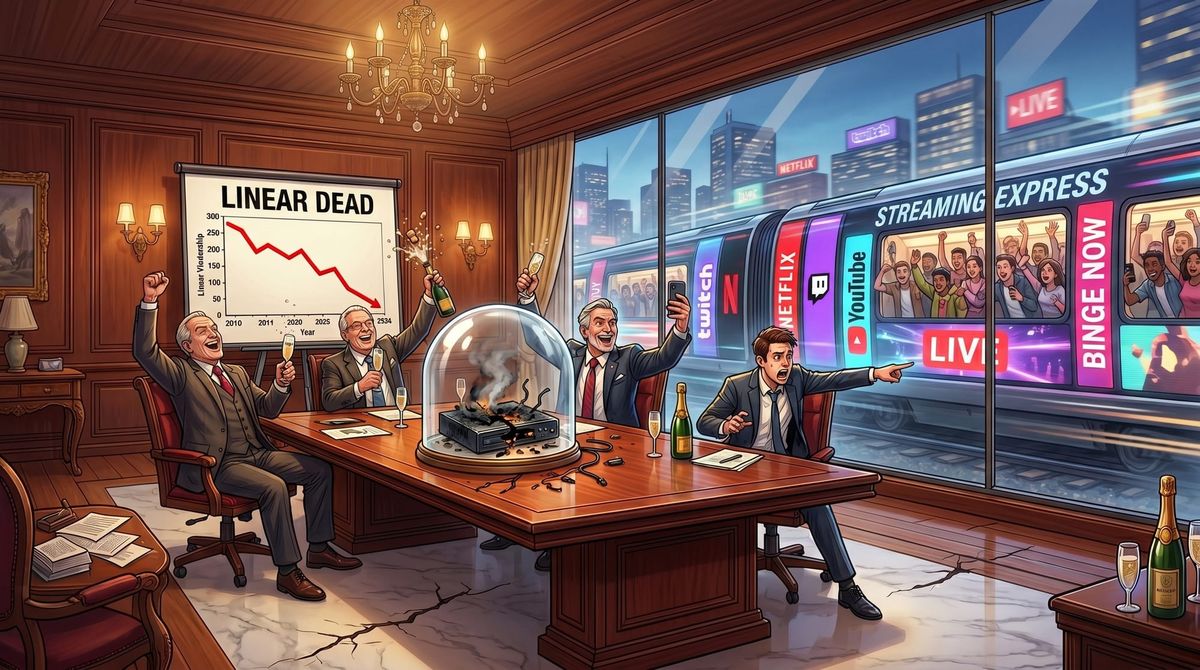
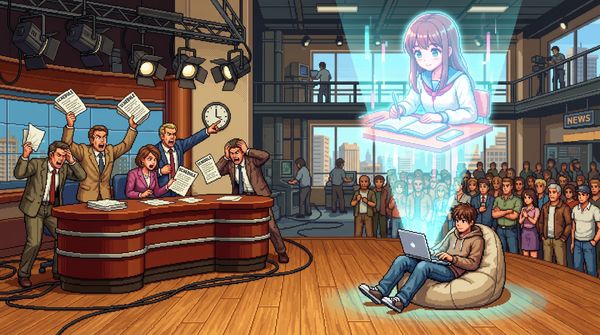
Legacy media spent a decade misreading Gen Z. The audience never left linear television. The lean-back ritual never died. What migrated was the gatekeeping function — the next-thirty-seconds decision — and with it, every dollar of prime-time advertising.
Gen Z didn't abandon linear television. They switched networks.
The boardroom narrative says the opposite. It says attention spans collapsed, the grid is dead, the lean-back ritual is over. That narrative has powered a decade of strategy decks, tens of billions of dollars in prestige-original spending, and the slow accumulation of cultural irrelevance among legacy media companies that still can't explain why a nine-year-old USA Network legal procedural beat their entire 2023 originals slate.
The narrative is wrong. Not partially wrong — wrong in the specific, billion-dollar way that misroutes capital, programming, and ad inventory at every major holding company simultaneously.
The thesis this series will defend: social feeds are the new linear television. The For You page, the YouTube CTV home, the Shorts autoplay queue — these aren't replacements for linear. They are linear. Same psychological product the EPG delivered in 1995, running on different infrastructure, programmed by different gatekeepers.
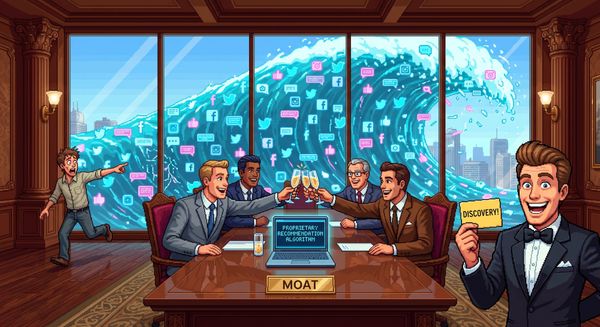
What died isn't linear television. What died is legacy media's ownership of the Control Layer — the surface where the next thirty seconds of programming gets decided. The Control Layer migrated to YouTube and TikTok years ago. The audience followed. The advertising followed. The cultural relevance followed. The boardroom is still writing strategy as if it didn't.
The Three Misdiagnoses
Every legacy strategy deck on Gen Z opens with the same three claims. Each is wrong. Each is wrong in a specific, measurable way.
Misdiagnosis one: the 8-second attention span.
It isn't an attention span. It's an 8-Second Evaluation Filter. Gen Z grew up in infinite-choice environments and developed a triage instinct for whether a piece of content deserves the next ninety minutes. Fail the filter, scroll. Pass it, watch for hours.
The proof is in the consumption data. 66% of Gen Z Americans say they often spend more time watching content that discusses or unpacks something — multi-hour video essays, gaming lore, internet-history documentaries — than they do watching the original source material itself (YouTube Culture & Trends, 2024). A 19-year-old who can't sit through a 45-minute Bridgerton episode will watch a 3.5-hour YouTube essay on Lord of the Rings production history at 1 AM. The attention is there. It just isn't pointed at legacy networks.
Roblox makes the same point quantitatively. The platform hit 144 million daily active users in Q4 2025, with 35 billion hours of engagement in the quarter — roughly 2.7 hours per user per day (Roblox Q4 2025 Letter). Q1 2026 added the demographic detail that drives the strategic point: the U.S. 18–34 cohort grew over 50% year-over-year, faster than any other user group on the platform (Roblox Q1 2026 Letter). The audience legacy media most wants to reach is migrating to a place legacy media doesn't program.
Misdiagnosis two: linear is dead.
Linear isn't dead. The cable box is dead. Two different deaths.
When major IP holders run 24/7 continuous broadcast loops on YouTube, the format works. SpongeBob SquarePants's always-on stream is the canonical example. Industry sources have told FASTMaster Intelligence that always-on IP channels routinely see live-loop viewership exceeding 70% of total title-page traffic — eclipsing the on-demand VOD library sitting right next to it.
Tubi's Stream 2026 report puts the stated preference at 77% on-demand over scheduled programming (Tubi Stream 2026). Worth a pinch of salt — an AVOD-first platform has commercial reasons to declare VOD the winner, and the framing concedes the wrong fight anyway. The relevant comparison isn't VOD versus scheduled linear. It's algorithmic linear versus everything else. The For You page, the YouTube CTV home, the autoplay queue — those are the new linear, and among under-35s they beat VOD and scheduled linear alike. The actual pecking order: algorithmic linear > VOD > scheduled linear.
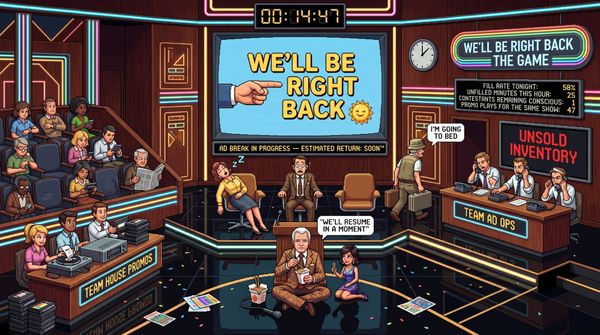
What died was the cable box, the 500-channel grid, the EPG. Legacy media kept confusing the delivery mechanism with the behavior.
Misdiagnosis three: Gen Z rejected storytelling.
This is the version that powered ten years of vertical-format experiments and short-form streaming apps. It's the most expensive misdiagnosis on the list because it's the one that justified the budget reallocation away from premium long-form.
Suits generated 57.7 billion viewing minutes in 2023 — a nine-year-old USA Network legal procedural, 134 episodes long, outperforming the year's top streaming original (Apple TV+'s Ted Lasso, 16.9B viewing minutes) by more than 3x (Nielsen Streaming Unwrapped, 2024). The viewing happened on Netflix — the streaming service most US viewers already had. The decision to watch happened on TikTok, where fragmented clips of Harvey Specter being a smug asshole in a good suit manufactured FOMO faster than any Netflix homepage carousel could.
Two ingredients had to be present for the explosion to happen. First, the new linear (TikTok) decided Suits was worth watching. Second, the show was sitting on a surface that didn't require a new subscription. Subtract either ingredient and nothing explodes.
Suits LA is the receipt. NBC greenlit the spinoff on the back of the original's 2023 numbers, brought back Gabriel Macht for cameos, and ran the same TikTok playbook — but locked the show to NBC linear and Peacock. It premiered to 2.6M viewers, fell to ~1M, and was cancelled after one season (Variety, May 2025). Same IP, different access layer, different result.
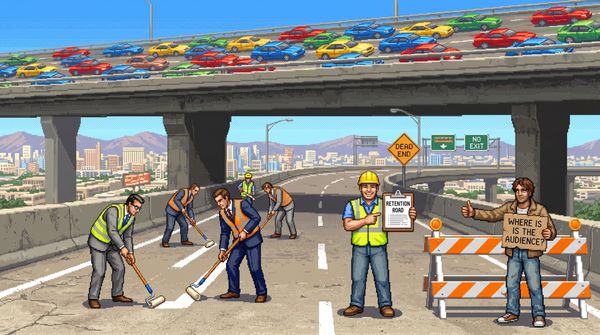
That's the model. The Control Layer doesn't just program the feed — it programs every screen downstream of it, but only if the show is somewhere the audience already lives. Legacy media keeps optimizing the downstream surface (better originals, better app, more prestige) and wondering why the upstream gatekeeper isn't sending traffic to the walled garden.
YouTube CEO Neal Mohan's Cannes 2025 keynote put a marker on the scale of the new linear: YouTube Shorts now averages 200 billion daily views — up 186% in a year — and viewers watch over 1 billion hours of YouTube on connected TVs every day (Search Engine Journal, June 2025). As of February 2026, YouTube alone accounts for 12.7% of all U.S. television viewing — more than Netflix, more than every traditional broadcaster (Nielsen February 2026 Gauge).
Parts II through V of this series map who those networks are, how the Control Layer monetizes, who the new gatekeepers actually are, and what legacy operators can — and cannot — do about it.
An audit of who actually owns Gen Z's living room.
Part I — Gen Z Didn't Kill Linear TV. They Switched Networks. (you are here)
Part II — Linear Was Never the Cable Box (5/9)
Part III — YouTube Is The New NBC. TikTok Is The New MTV. (5/11)
Part IV — Creators Replaced the Talent. Algorithms Replaced the Programmers. (5/13)
Part V — The Three Delusions Legacy Media Won't Abandon (5/15)
Conclusion — Gen Z Didn't Kill TV. Legacy Media Stopped Owning It. (5/19)