Show Discovery Has Two Surfaces. Streamers Need Both.
Streaming AI search has two surfaces, not one. Inside-app handles retention. Inside-LLM handles acquisition. They cover different moments in the discovery funnel and they are not substitutes.

On April 7, 2026, Tubi launched a native app inside ChatGPT. Users install the Tubi app from the OpenAI app store, type @Tubi in any prompt, and get recommendations pulled live from Tubi's catalog of 300,000+ titles, with playback links straight back to Tubi.
It is the first major US streamer to build inside an LLM. It is also the most strategically interesting move any streamer has made in two years, and almost no one in the trade press framed it correctly. The framing on the news pages was "Tubi adds AI search." The framing that matters is "Tubi has tested both architectures, learned from the first one, and pivoted."
That last clause is the part the trades missed. Tubi has run both experiments — in-app AI in 2023, then inside-AI in 2026. The strategic conclusion isn't either-or; it's both. Netflix is still on Tubi's first experiment, twenty months late, with no commitment. The other major operators have not started.
Part One mapped the funnel: discovery has moved off-platform, and the metadata work to compete there is sitting unused. This analysis is about which surface in that funnel an operator builds for — and why the right answer is more than one.
Disintermediation Is a Metadata Story
The standard framing of the news publisher collapse of 2024–2026 is a traffic story. Google launched AI Overviews in May 2024, summaries appeared at the top of search results, users stopped clicking through, ad revenue evaporated. By July 2025, Pew had documented that when an AI Overview appears, click-through to traditional results drops from 15% to 8%. The Verge's editor publicly called it "an extinction-level event."
The traffic story is the consequence. The mechanism is metadata.
AI Overviews work by aggregating publicly indexed metadata — headlines, lede paragraphs, structured fields, schema markup — and combining it into a direct answer. Publishers spent two decades building that metadata. Search engine optimization is, fundamentally, the discipline of making metadata legible to a search engine. The work publishers did to be findable became the raw material for the system that made them invisible.
Whoever controls what to do with the metadata layer — and how publicly to expose it — controls who shows up in the answers.
The Streaming Case Is Structurally Identical
LLMs answer streaming queries by pattern-matching against publicly available metadata about content: Wikipedia, Letterboxd, Rotten Tomatoes, EIDR records, scrapable EPG feeds, IMDb structured data, the markup on streamers' marketing pages. Newer products — Perplexity, ChatGPT with browsing, Gemini, Claude — supplement training data with live retrieval. Pages that respond fast and parse cleanly get cited; pages that don't, don't.
The behavioral evidence is that this is already happening at meaningful scale. Tom's Guide, BGR, TechRadar, and Yahoo Tech have all published "I asked ChatGPT what to watch on Netflix" guides. The canonical query is the cross-stack prompt: "I have Disney+, Netflix, Prime Video, Paramount+, HBO Max, Apple TV. I like science fiction. What should I watch tonight?"
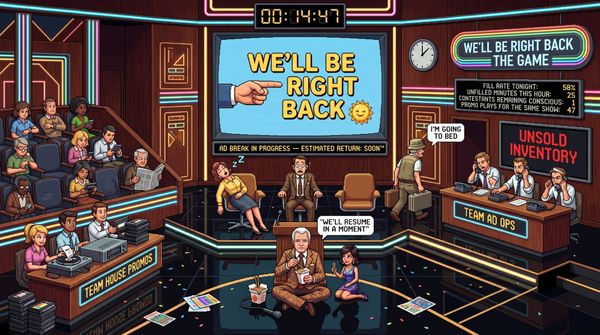
That query is the New EPG. It is the moment at which the discovery decision is actually being made. And it is happening on a surface no streamer operates.
The mechanism by which the LLM answers is closer to pattern-matching from training data than to live cross-catalog search, which is why these recommendations sometimes get rights windows wrong. But the user-experience effect is that one prompt produces one answer that crosses every wall the streamers maintain. The streamer cited in that answer is the streamer whose metadata was reachable to the LLM at training or retrieval. The streamer whose richest metadata sits behind a Login Wall is not cited, because the LLM cannot reach the metadata.
This is the news publisher mechanism, applied to streaming.
Tubi Resolved the Fork. Netflix Hasn't.
The trade-press shorthand is that Netflix and Tubi represent two competing strategic responses. That shorthand erases the timeline. Tubi was first on the in-app architecture by twenty months — and abandoned it.
In September 2023, Tubi launched "Rabbit AI" — a ChatGPT-4-powered content discovery tool built inside Tubi's own iOS app. Users typed natural-language requests; Tubi's recommender, augmented with OpenAI's model, returned titles from Tubi's catalog. The product shape was identical to what Netflix would announce in 2025. Tubi shut Rabbit AI down in 2024.
The Rabbit AI Experiment
September 26, 2023: Tubi launches Rabbit AI as an iOS beta, powered by ChatGPT-4, against a library of 200,000+ titles. Users type natural-language requests ("Do you have any movies that are funny about sharks?") and Rabbit AI returns curated results. The search-history feature is called "Rabbit Holes."
2024: Discontinued. No public post-mortem; later coverage attributes the shutdown to low adoption.
May 7, 2025: Netflix launches a structurally identical product — ChatGPT-powered in-app search, iOS opt-in beta, mobile only — twenty months after Rabbit AI's debut, eighteen months after Tubi pulled it.
April 7, 2026: Tubi launches its native app inside ChatGPT — the opposite architecture.
In May 2025, Netflix announced its own ChatGPT-powered in-app search — opt-in beta, iOS only, mobile only, with prior testing limited to Australia and New Zealand. A year on, the feature still has no global rollout. There has been no significant product update since the May 2025 announcement. The experiment is running, but Netflix has not committed to it as a strategic position.
In April 2026, Tubi launched its inside-ChatGPT app. Users no longer come to Tubi to use the AI; they come to the AI and Tubi shows up. CPO Mike Bidgoli framed the move as "meeting viewers in the moment they're expressing intent in their own words." CEO Anjali Sud told Fast Company that "Gen Z, Gen Alpha — they expect that streaming should feel as easy and personalized as when they open up Instagram or TikTok."
The sequence matters. Tubi did not arrive at the inside-AI strategy by skipping the in-app one. Tubi tested the in-app one first, ran it for roughly a year, and pivoted. Netflix is on the experiment Tubi started in 2023 and abandoned in 2024 — and a year past Netflix's own announcement, the rollout still hasn't happened.
The strategic limit Tubi hit is the same limit Netflix is hitting. An in-app conversational tool cannot recommend across competitors' catalogs. A subscriber asking "I have six streaming services, what should I watch" inside Netflix's chat gets an answer drawn entirely from Netflix's library — which is not the answer the subscriber asked for. The subscriber asked for the best title across six services. Netflix's chat can only answer with the best title across one. A user with cross-stack discovery needs has no reason to use Netflix's in-app chat for that purpose, and increasing reason to use a third-party LLM instead.
That is the limit that killed Rabbit AI. There is no available reason to think Netflix will not hit it as well.
The Infrastructure Problem Under the Strategic Problem
The Tubi move is replicable for any title-led SVOD. Netflix, Disney+, Max, Prime Video, Apple TV all have deep-linking infrastructure that already supports a "click here, watch this title" handoff from an external surface. Where the architecture breaks down is FAST. FAST channels — and the FAST-equivalent linear channels embedded inside Peacock, Paramount+, the Roku Channel, and others — are mostly not deep-linkable in the way a single SVOD title is. Pluto TV supports channel-level links on web. A handful of others have partial support. Prime Video's FAST tier does not. Adoption across FAST and PAST operators is narrow and inconsistent.
This matters because the inside-AI move depends on the LLM being able to send the user to a specific destination — a title, a channel, a moment — and have the destination open. Tubi's catalog is title-led and the playback links work. A FAST operator whose differentiator is a specific channel running a specific block of programming has a harder problem: even if the LLM correctly recommends "the cozy '90s sitcom block on Channel X," there is often no link that opens Channel X at that moment.
Whichever cloud playout or distribution platform solves channel-level deep-linking at scale across the FAST stack is solving a quiet but load-bearing piece of the metadata-distribution problem. Without that fix, the operators most exposed to LLM-mediated discovery — the FAST and PAST operators competing on programming density rather than title catalog — are the ones least able to follow the Tubi move.
Proprietary Metadata Was a Moat. It's Now a Wall.
For fifteen years, streamers treated their richest descriptive metadata — micro-genres, mood tagging, scene markers, viewing-pattern affinities — as competitive intellectual property. The competitive logic was straightforward: a better internal recommender produced better retention, which produced better unit economics. Netflix's micro-genre system was the canonical example; every major operator built similar internal layers.
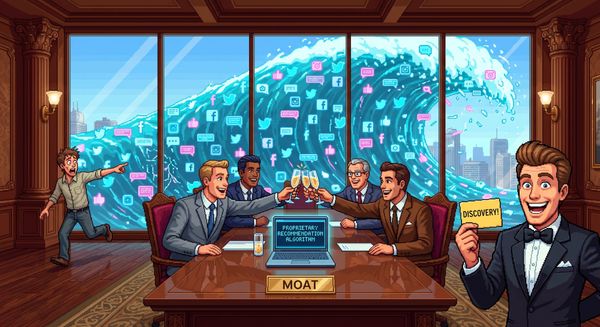
That logic worked when discovery happened inside the app. It does not work outside the app. LLMs cannot see metadata that lives behind a Login Wall. They cannot see metadata that lives in a proprietary recommender. They cannot see metadata that exists only as internal scoring vectors used by a personalization engine. They can only see metadata that is publicly indexed.
The streamer with the richest hand-curated tagging in the industry will be cited less often in LLM answers than a competitor whose metadata is thinner but public. Not because the LLM thinks the thinner metadata is better — but because the LLM cannot consult the richer metadata. Invisible metadata is functionally absent metadata. The fifteen-year strategic assumption was correct for the operating environment that produced it; the same metadata, in the same proprietary form, is now keeping the operator out of the answers rather than keeping competitors out of the operator's customers.
News Publishers Already Took the Test
Part One detailed how the publisher response to AI-mediated discovery split into two camps in 2024. The Closed Garden defenders sued and blocked — the New York Times' December 2023 lawsuit against OpenAI and Microsoftwas the highest-profile version. The licensors signed — News Corp's five-year, ~$250M deal with OpenAI in May 2024, the Atlantic and Vox within a week, Time, Reddit, Hearst, Condé Nast, the Financial Times, and Axel Springer through the rest of 2024.
Twelve months on, the lesson is unambiguous. The Washington Post lost 40% of its organic search traffic. The Atlantic CEO Nicholas Thompson told staff to assume Google traffic would drop toward zero. Across the industry, Business Insider was down 55% and cutting headcount by 21%, HuffPost and Forbes down roughly 50%. The publishers who licensed early are not whole — no one is — but they are not the ones cutting staff because of "extreme traffic drops outside of our control."
The strategic lesson is uncomfortable but clear. Refusing to participate in LLM-mediated discovery does not protect the discovery surface. It just removes the operator from the surface that is replacing the one they used to control.
The Optimal Move Is Both Surfaces
Here is the part the Netflix-vs-Tubi binary obscures. The two surfaces are not substitutes. They serve different moments in the discovery funnel. The strongest strategic position is presence at both — in-app AI for the user already inside, in-AI presence for the user at the moment of cross-stack intent.
The in-AI surface captures the user before any app is open, when the cross-stack query is being formed, when the user is choosing between subscriptions or simply asking for something to watch. This is the acquisition surface. Tubi's 2026 bet is here. The publisher licensing deals are the structural equivalent.
The in-app surface captures the user who is already inside the operator's product — has a subscription, has opened the app, is browsing, and needs help finding the right thing in the operator's catalog. This is the retention surface. Netflix's experiment is here. The work is real and the surface still matters; the limit is that it does not address the cross-stack query.
An operator with a polished in-app conversational discovery tool and a native presence inside ChatGPT, Perplexity, Gemini, and Claude has covered both moments. An operator with only the first — Netflix's current position — is uncovered at acquisition. An operator with only the second is uncovered at retention. An operator with neither is news publishers in 2025.
The realistic implementation is three moves in parallel.
Surface inside the LLM layer. Build presence on the surface where cross-stack discovery is happening. Native apps inside the major LLMs. Structured licensing arrangements that put proprietary descriptive metadata into LLM training in exchange for revenue share, attribution, or guaranteed surfacing.
Optimize for surfacing in untrained channels. Even without a direct LLM relationship, a streamer can make its metadata more reachable to the LLMs that already exist. The discipline emerging in publishing is called Generative Engine Optimization. The techniques: structured data using schema.org/Movie and schema.org/TVSeries; descriptive language in marketing pages that uses the vocabulary humans actually search by — mood, aesthetic, era-feel — rather than only the EPG fields the LLM already has elsewhere; fast-loading, semantically clean pages that retrieval-enabled LLMs can parse quickly; clear deep-link structure so when an LLM cites a title, the user clicks through to playback.
Strengthen the in-app discovery surface for the users already inside. The in-app recommender is not obsolete. It is just demoted from acquisition to retention. The work here is making the in-app surface good enough at retention that the user does not churn to a service that surfaced more visibly in their last LLM query.
The first response — full defensive crouch, treat LLMs as a threat, block everything — failed in news. There is no available evidence to suggest it will succeed in streaming. The streamers who try it in 2026 will look like the publishers who tried it in 2024.
The Window Closes on the Half-Committed
A meaningful share of streaming discovery is already happening in LLM answers. That share is growing. Every viewer asking ChatGPT what to watch tonight is a viewer the operator either reaches or loses.
The news publisher trajectory ran from "AI Overviews launch" to "publishers who held the line are unrecoverable" in roughly twelve months. Twelve to eighteen months is the reasonable estimate of how long the streaming window stays open. After that, the operators who held the wall will be licensing their way back in from a position of weakness — and the operators who covered only one of the two surfaces will be hitting the same limit Tubi hit with Rabbit AI, eighteen months too late to pivot cleanly.
Tubi has tested both surfaces and committed to one. Netflix is on the first surface and has not committed. The other major operators have not started.
The strategic question is not which surface to choose. It is whether to be present at both. Half-commitment is the most expensive position in the room.
Build for both surfaces.