Discovery Has Left Streaming. Metadata Decides Who Follows.
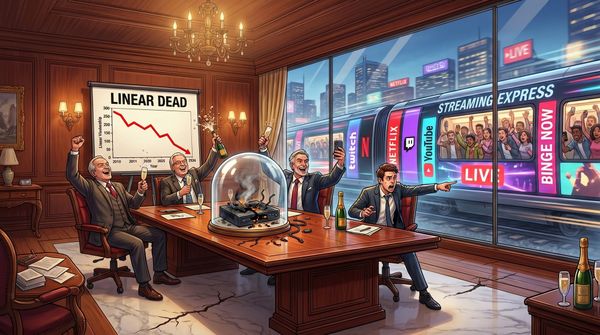
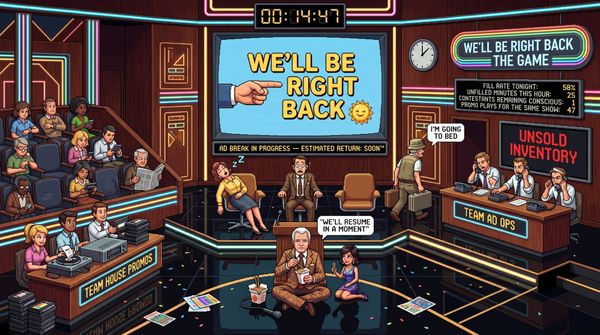
Proprietary recommendation was the moat. It isn't anymore. Discovery happens on TikTok, Letterboxd, and inside ChatGPT — and the metadata work to compete there is sitting unused.
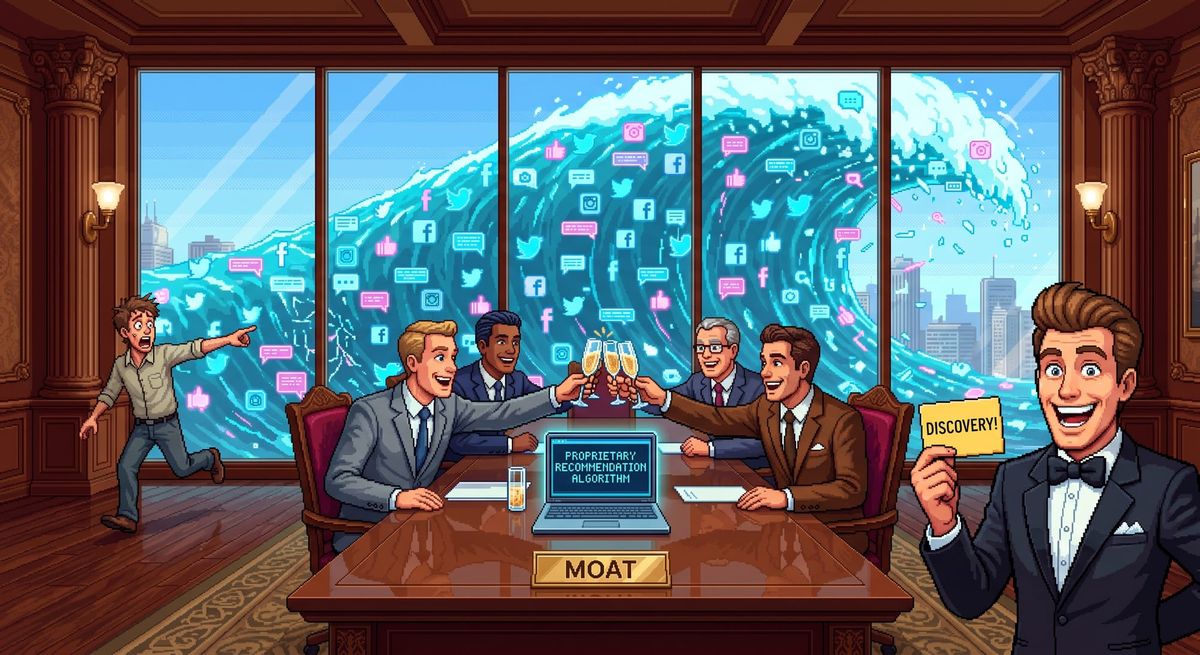
Streaming's metadata layer is fifteen years old and was built for the wrong job. It was built to populate rows on a home screen — genre, cast, year, runtime, rating — for users who had already opened the app. It was not built to compete in the surfaces where viewers now decide what to watch before they open anything: TikTok, Letterboxd, ChatGPT.
That mismatch is the rhino in the room. The Electronic Programming Guide isn't broken in usability. It's broken in vocabulary — built to sort forty broadcast channels into six bins, then inherited by streaming and asked to scale to catalogs four orders of magnitude larger. The recommender was supposed to cover the gap. It didn't. The cohort that defines the next decade of revenue routed around the EPG and the recommender both, and went looking for descriptive vocabulary somewhere else.
The data on where they went is unambiguous. 86% of Gen Z search on TikTok every week (WARC/TikTok, July 2025). Total TikTok searches are up 40% year-over-year. 65% of Gen Z respondents have used TikTok as a search engine (Adobe Express, January 2026). Gen Z uses Google 25% less than Gen X (Forbes Advisor with Talker Research, May 2024).
These are behavioral facts, not strategic ones. They tell you where Gen Z went. They don't tell you why — and the why determines what better metadata can, and cannot, fix.
Genre Is a Scarcity Vocabulary
Genre did real work in broadcast. Forty channels, six bins — drama, comedy, action, news, sports, reality. The EPG made the taxonomy legible at a glance, and the taxonomy was sufficient.
Streaming dropped the same vocabulary into an environment where the catalog is effectively infinite and attention is finite. Netflix has roughly 7,800 titles in its US catalog. "Drama" is not a useful bucket among 7,800 things. It's a meaningless one.
Streaming's response was sub-genres on top — psychological thriller, dark comedy, prestige drama — and proprietary layers underneath. Netflix's micro-genre system, with strings like "visually-striking forceful drama" and "Oscar-winning quirky comedies based on real life," is the canonical example. Tens of thousands of tags, generated by algorithmic clustering plus human editorial work. Richer than genre, yes. Also proprietary: exposed only inside Netflix's recommender, used to drive home-screen rows, not to answer queries.
Gen Z built a different vocabulary for the same problem: mood (cozy, tense, anxious, melancholy, escapist), aesthetic (Y2K, neon-noir, Wes Anderson-adjacent, '70s grain), era-feel, pacing, tonal adjacency. The query isn't "romantic comedy." It's "something cozy and short," or "shows that feel like Fleabag," or "the visual palette of Wong Kar-wai but lighter."
Better metadata answers most of those queries. The EPG answers almost none.
This is the core mechanism. Everything else is consequence.
TikTok Is a Metadata-Rich Interface
The dominant explanation treats TikTok's emergence as a search engine as an algorithm story. The For You page is so well-tuned to user preferences that it surfaces relevant content faster than Google's keyword-driven results.
That explanation is incomplete. On TikTok, the content itself is metadata. A 30-second clip carrying color palette, dialogue cadence, lighting, music cue, and emotional register conveys more about a film's texture than any structured field a streamer ships. The viewer doesn't read a description that fails to capture the vibe. They see the vibe. TikTok's search isn't really search — it's semantic retrieval against a corpus of video clips that carry the descriptive payload natively.
This is the threshold streaming hasn't crossed. The metadata layer was built around fields, not video. The existing video assets — trailers, promo clips, hero images — were curated for marketing, not discovery. Frame-level tagging, scene-level mood markers, AI-generated descriptive layers — these are emerging as commercial products. The gap is still wide enough that a viewer asking "what's a cozy show I haven't seen" gets a better answer from TikTok than from any streamer's home screen. Today.
The Four-Step Funnel
A streaming-fluent Gen Z viewer arrives at a piece of content through a four-step sequence. Operators should map it as a literal funnel.
Step one. Surfacing. A clip surfaces in the TikTok For You feed: a fan edit, a Letterboxd tier list, a creator's "movies that feel like autumn" video. The viewer hasn't asked for it; the algorithm supplied it. The clip carries enough texture that the viewer immediately knows whether they're interested.
Step two. Identification. The viewer needs the title — the original clip often didn't name it, or named it on screen for half a second. Three dominant patterns: scrolling the comments, searching TikTok itself for more clips, or screenshotting and feeding the image to ChatGPT or Google Lens. TikTok search is less common because it's better at what something feels like than at what something is called.
Step three. Availability. Having identified the title, the viewer needs to know where to watch it. JustWatch and Reelgood were purpose-built for this. They're now competing with — and often losing to — a different mechanism: telling an LLM which subscriptions you have and asking for a recommendation across the stack. "I have Netflix, Disney+, Prime, Max, Apple TV. What should I watch tonight?" One prompt, one answer that crosses every wall the streamers maintain. The mechanism is closer to pattern-matching against training data than live cross-catalog search, which is why these recommendations sometimes get rights windows wrong. The user-experience effect overwhelms the accuracy gap.
Step four. Playback. The viewer opens the relevant streamer's app, finds the title (sometimes via deep-link from the LLM, often via fresh search inside the app), and starts watching.
Three of those four steps happen on platforms the streamer doesn't operate. The streamer's recommendation engine — long regarded as a core competitive moat — enters the funnel at the lowest-leverage point. By the time the viewer is inside the app, the discovery decision has already been made. The recommender's job has been demoted from acquisition to retention.
The Metric Streamers Aren't Reporting
The most diagnostic number for this disintermediation is Off-Platform Origination: the share of session starts that begin outside the platform's own EPG and recommendation surfaces. A session start triggered by an LLM deep-link, or by a search query the viewer entered after seeing a TikTok clip, is structurally different from one originated by browsing the home screen. The ratio reveals how much of the discovery work the platform is actually doing.
No major streamer publishes this number. Internal teams can construct it from referrer data, deep-link parameters, and search-query origin metadata. Some streamers track variants of it privately. None disclose it. The first major streamer to report it will be acknowledging that the EPG has lost its monopoly on discovery — which is why none of them want to be first.
The metric matters because it's the leading indicator for the cohort. Off-Platform Origination among under-25s is already substantial. And growing. As that share grows, proprietary recommendation gets eroded as a moat — not because the recommendation work is wrong, but because it's happening at the wrong layer of the funnel.
Better Metadata Determines Who Surfaces
The funnel can't be recaptured. The behavior is set, the platforms are entrenched, and no single streamer has the leverage to drag discovery back inside its walls. Better metadata doesn't recapture the funnel — it determines whose titles surface at each step of the funnel that already exists.
The descriptive layer Gen Z searches by includes:
Mood and tonal tags. Cozy, tense, anxious, melancholy, escapist, comforting, contemplative, propulsive. Granular enough to support queries like "something cozy and short." Most of this exists inside Netflix's micro-genre system already. Almost none of it is exposed outside the app.
Aesthetic and era markers. Y2K, neon-noir, Wes Anderson-adjacent, '70s grain, '90s indie, Gen-X-mall, weeknight-network. The descriptive primitives that show up in TikTok captions and Letterboxd tags but rarely in EPG data.
Pacing descriptors. Slow-burn, propulsive, episodic, serialized, prestige-pacing, podcast-pacing. Critical for the "what should I watch while I do something else" query that drives much of streaming time.
Affinity tags between titles. Which titles' audiences overlap in non-obvious ways. People who liked Fleabag also liked I May Destroy You, derived from viewing data, social signals, or critical co-citation. Some of this exists in Netflix's recommender. Most lives in Letterboxd's user-generated tag layer and Reddit's recommendation threads — scattered and unstructured.
Scene-level entry points. Where does the cozy scene start? Where does the action peak? This is the layer being pitched now under the "frame-level metadata" banner. Commercially nascent, technically solvable, and almost no one is exposing it publicly today.
Creator-lineage tags. Cinematographer, composer, showrunner-lineage, production-company DNA. The data exists in IMDb-style structured form but isn't connected to mood or aesthetic in a way searchers can query against.
Most of this descriptive richness already exists somewhere. The work isn't generation. It's consolidation, standardization, and the choice of what to expose.
The Work Is Industrialized; Only Exposure Is in Question
Producing descriptive metadata at the depth this funnel demands used to be a manual content-ops project. It isn't anymore. AI tooling ingests content, generates mood and EPG-compliant descriptions, and prepares assets for distribution at production scale. Some of the build-out is happening inside the streamers. Most is happening at the supply-chain layer — cloud playout, orchestration platforms, ad-tech vendors.
This changes the question. The question is no longer whether operators can produce descriptive metadata at depth. They can. The tooling exists, the cost has been industrialized. The question is where operators expose it, because metadata only does work where it can be reached.
LLMs reach metadata through three channels.
The first is training-data scrapes. When OpenAI, Anthropic, Google, and the other model developers train, they ingest publicly available web content. The pages that surface well are Wikipedia entries, Letterboxd tags, Rotten Tomatoes synopses, IMDb structured pages, Reddit threads, and any HTML page using schema.org markup (specifically schema.org/Movie and schema.org/TVSeries). A streamer whose marketing pages carry rich structured markup, with mood and tonal descriptors expressed in standard form, will appear in training data with accurate descriptive metadata. A streamer whose pages are JavaScript-heavy, slow-loading, or marked up only with title-and-description fields will not.
The second is live retrieval. Newer LLMs — Perplexity, ChatGPT with browsing, Gemini, Claude with web access — supplement training data with real-time lookups against the live web. Pages that respond fastest and parse cleanest get cited.
The third is direct licensing. A streamer could license its proprietary descriptive metadata directly to LLM platforms in exchange for revenue share, attribution, or guaranteed surfacing of titles in relevant queries. The infrastructure exists. No major streamer has done it at scale.
The channels through which LLMs reach content metadata are public surfaces. The operators most aggressive about feeding those surfaces will dominate LLM-generated recommendations. The operators whose richest descriptive data sits behind the Login Wall, inside a proprietary recommender, will not.
This inverts the fifteen-year assumption that proprietary metadata is a competitive advantage. It was, when discovery happened inside the app. When discovery happens outside the app, metadata behind the Login Wall is invisible — and the discovery decision gets made without the operator in the room.
Three Responses, One Already Failed
Streaming operators face a choice that mirrors the choice news publishers faced in 2024.
The first response: defend the Closed Garden. Block AI crawlers, sue scrapers, withhold metadata from training, treat the LLM layer as a threat. Some publishers tried this — most prominently the New York Times in its December 2023 lawsuit against OpenAI and Microsoft. Others took the opposite tack early: News Corp signed a five-year, ~$250M licensing deal with OpenAI in May 2024, with The Atlantic and Vox Media following within a week.
The Closed Garden defenders watched their organic traffic collapse over the next twelve months. Business Insider lost 55% of its organic search traffic between April 2022 and April 2025, leading to staff cuts of 21%. Forbes and HuffPost each lost roughly 50%. News publishers overall lost more than 600 million monthly visits in twelve months — organic search traffic falling from 2.3 billion at peak in mid-2024 to under 1.7 billion by May 2025. The publishers who licensed early aren't whole — no one is — but they aren't the ones cutting headcount because of "extreme traffic drops outside of our control."
The second response: invest in surfacing. Build the descriptive metadata, expose enough of it to public knowledge graphs that LLMs can correctly identify and recommend titles, optimize marketing pages for structured-data compliance and live retrieval, negotiate licensing arrangements that put proprietary descriptive data into LLM training without losing commercial control. The discipline emerging in publishing is called Generative Engine Optimization. The streaming-industry equivalent doesn't have a name yet. The work is the same.
The third response: build the in-app discovery surface LLMs cannot replicate. Invest in deep-link continuity so when an LLM does recommend a title, the viewer lands inside the app at the playable asset, not a generic landing page. Netflix's mobile ChatGPT-style search integration is one example — defensive in intent, architecturally sound. The strategic limit: Netflix's in-app conversational search cannot recommend across competitors' catalogs, and the cross-stack query is the canonical query of the new EPG. Tubi went the opposite direction in April 2026, becoming the first major streamer to launch a native app inside ChatGPT itself. Users type @Tubi in any prompt, get recommendations pulled live from Tubi's catalog, and click through to direct playback.
The realistic strategy is some combination of the second and third, supported by the metadata-generation tooling industrialized at the supply-chain layer. The first response failed in news. It will fail in streaming.
Where the Decade Gets Decided
Streaming spent fifteen years optimizing recommendation for users already inside the app. Retention, watch time, completion rate — every metric the industry rewards lives at the bottom of the funnel.
The next decade gets decided before the user opens the app. The metadata work to compete on that surface can be done — the tooling exists, the cost is industrialized. The question is whether operators choose to do it, and whether they expose the result where the discovery decisions are now happening.
Gen Z is choosing what to watch tonight on surfaces the streamer doesn't operate. The operator whose titles are described well enough to surface in those answers gets the next decade of viewers. The operator whose richest descriptive data sits behind the Login Wall does not.
Choose accordingly.