YouTube Stations Will Be The FAST Suppressor
How YouTube Stations Will Cap Legacy Linear's Growth Ceiling and Strangle Its Future Audience
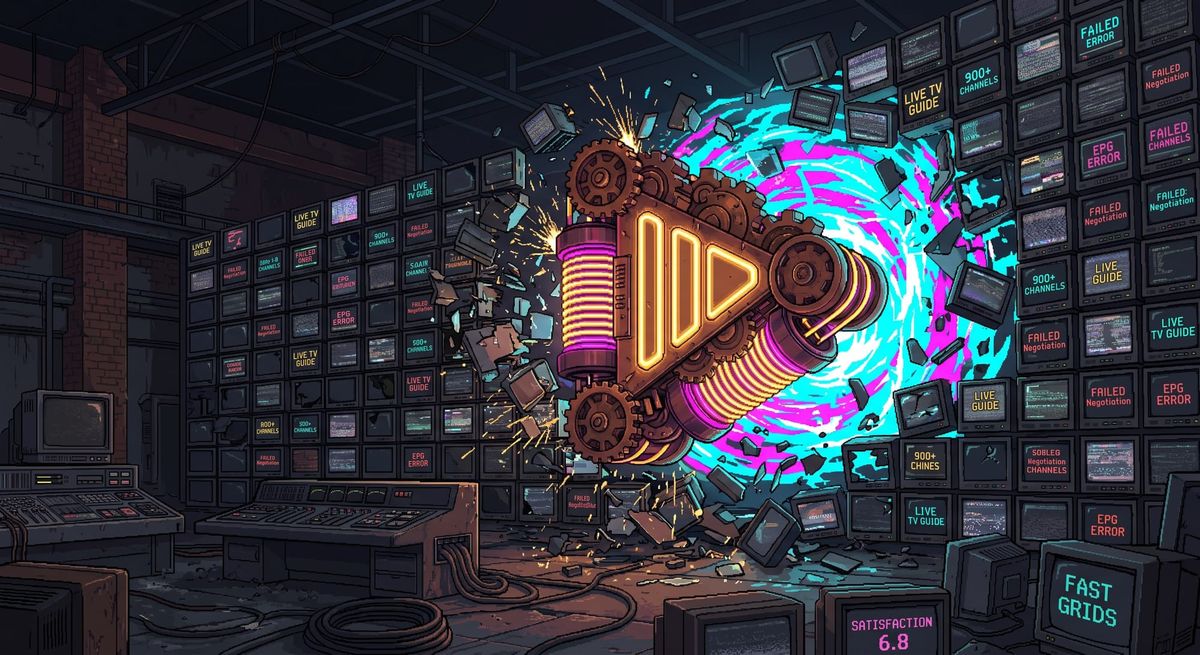
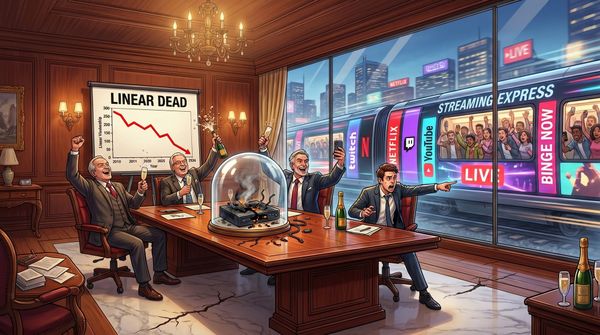
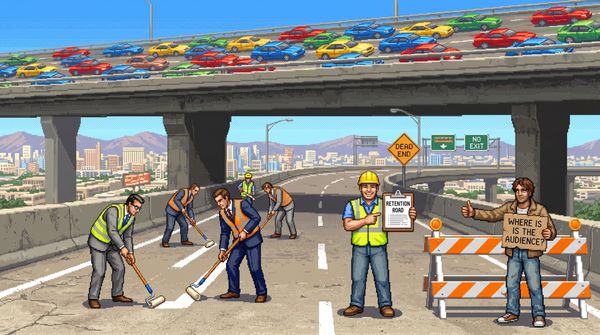
YouTube Stations will not execute legacy FAST in a single product cycle. But it will permanently cap the category's growth ceiling, siphon programmatic ad dollars out of the free-streaming industry, and lock the next generation of television viewers into algorithmic feeds before they ever encounter an EPG grid. This is slow strangulation, not sudden death.
A 22-year-old creator in their childhood bedroom will soon be able to launch a 24/7 linear television channel in under three minutes. One click inside YouTube Studio, a curated playlist of existing videos, and YouTube's servers handle the rest — automatically stitching pre-recorded clips into an endless livestream with live audience chat and seamless CTV rendering. No broadcasting software. No encoder. No carriage negotiation.
Meanwhile, a legacy media conglomerate wanting to launch a new FAST channel on Samsung TV Plus, LG Channels, or Vizio WatchFree+ faces a six-to-twelve-month process: carriage negotiations, ad-serving integration, content licensing reviews, EPG metadata work, seven-figure backend investments. By the time that corporate FAST channel ships, 50,000 creators will have each launched their own.
This asymmetry is the central fact of the next era of free streaming. YouTube Stations, announced earlier this month by Janko Roettgers at Lowpass, represents a suppressor on legacy FAST's entire growth trajectory — capping its future ceiling, siphoning programmatic ad dollars out of the category, and ensuring that Gen Z and Gen Alpha viewers never adopt the traditional FAST interface in the first place.
PART I: Why YouTube Gave It Away
To understand why YouTube is handing broadcast technology to its creator base, look at the living room ad dollars at stake.
YouTube's ascent to the #1 slot in U.S. TV viewing was not a flash event. In January 2025, Disney posted its best month ever in the Media Distributor Gauge at 12.0% share, driven by the College Football Playoffs. The very next month, YouTube took the lead — and held it through the remainder of 2025 and into 2026.
February 2026 interrupted the streak — but only with a giant asterisk. NBCUniversal+Versant topped the chart at 13.1%, driven almost entirely by Super Bowl LX and Winter Olympics simulcasts on Peacock and NBC. When March 2026 numbers drop, YouTube is almost certain to be back on top.
But the more revealing data point in the Feb 2026 release is what happened to everyone else. Disney dropped 2.0 share points. Paramount-WBD dropped 1.3. Fox dropped 0.8. Netflix dropped 0.4. Every legacy SVOD and conglomerate lost share to the NBCU+Versant event spike. YouTube gained 0.2.
Americans watched the Super Bowl and the Olympics and watched more YouTube anyway. Legacy distributors compete with each other for finite viewer hours. YouTube operates on a parallel layer that event programming cannot disrupt. That is not a platform with a ceiling. That is a platform with a different shape of demand.
YouTube's Connected TV ad revenue will hit $9.21 billion in 2026 — nearly 12% of all U.S. CTV ad spending — and Stations is the mechanism that converts creator-economy hours into premium CTV inventory at industrial scale. The inventory generates itself.
Gen Z now spends 60% of their video hours on free services — and the vast majority of those hours go to YouTube (28%) and TikTok/Reels (29%). Free streaming captures 3% of Gen Z's video hours.
Among millennials, free streaming does slightly better at 9%, but still loses decisively to YouTube (21%) and TikTok/Reels (16%). Even Boomers — the cohort most favorable to legacy linear — give YouTube 13% of their video hours against free streaming's 10%. YouTube leads every measurable generation. Gen Alpha is already spending the overwhelming majority of its video time inside YouTube. The lock-in is total.
When BCG asked viewers which single service matters most to their overall streaming experience, 51% of Gen Z named YouTube or TikTok/Reels as their #1 — versus 21% for Netflix. This is not a split decision. Algorithmic feeds are, to the Gen Z consumer, the most important video services in their lives.
Millennials and older cohorts still lean on Netflix and other SVODs, but the generational pattern is unambiguous: the incoming consumer class prioritizes algorithmic platforms over premium subscriptions, and legacy free streaming barely registers (1% among Gen Z).
The ad-supported streaming shift is real — but it's two shifts, not one. Paid SVOD ad tiers became a major growth engine for Netflix, Disney+, Prime, and Max. Free streaming grew too, but YouTube and TikTok captured the overwhelming majority of that growth. Legacy free-streaming platforms got the crumbs.
PART II: The Satisfaction Flip
On BCG's 1–10 consumer satisfaction index, YouTube scores 7.8 — above every single paid SVOD service except Netflix (8.1). TikTok, at 7.6, ties HBO/Max and ranks above Paramount+ (7.5), Hulu (7.5), Prime Video (7.4), ESPN (7.4), Disney+ (7.3), and Peacock (7.2). The algorithmic platforms are not merely winning on attention — they are winning on subscriber experience.
Traditional free-streaming platforms trail the entire pack. Tubi scores 7.1, Pluto TV 6.8, and Roku Channel dead last at 6.6 — below every other measured platform, paid or free. The satisfaction ceiling for free streaming is not just lower than YouTube's; it is structurally the worst-rated category in the BCG dataset.
This is not a platform winning on price. This is a platform winning on product. Viewers paying premium fees for Netflix, HBO, Paramount+, Hulu, Prime, ESPN, Disney+, and Peacock simultaneously rate YouTube more satisfying than any of them except Netflix.
Rolled into reason categories: 64% of Gen Z use YouTube for content-related reasons. Only 18% cite price. UI/UX accounts for another 18%.
For non-Gen Z cohorts, content reasons still dominate at 58%, with price at 25% and UX at 18%. Legacy platforms have spent a decade building competitive strategy around the assumption that YouTube's moat was cost. None of that works if the moat is actually the content and the creators.
Among Gen Z, "Creators" is the #1 reason for using YouTube at 22% — above "Free" at 18%. "Content teaches me things" also ranks 18%.
In the demographic the free-streaming industry most needs to attract, YouTube is not "the free option" — it is the creator destination. The platform has spent fifteen years building an atomic, native, creator-first experience that no legacy FAST platform can replicate without acquiring YouTube itself.
This is the finding that should terrify every legacy FAST and SVOD strategist. If price were the moat, legacy platforms could compete — offer a cheaper tier, a better promotion, a free trial. But you cannot out-promote a creator relationship. The Gen Z viewer who watches MrBeast, Emma Chamberlain, or Kai Cenat is not comparison-shopping against Tubi or Paramount+.
Legacy platforms are trying to close this gap. Samsung TV Plus has signed Mark Rober, MrBeast, Dhar Mann, The Try Guys, and others to dedicated FAST channels, even commissioning Dhar Mann originals. Tubi has built a 5,000-episode creator library through its "Tubi For Creators" program and a March 2026 TikTok incubator partnership.
But these are bespoke, hand-negotiated deals for marquee talent. Stations gives that same capability to every one of YouTube's millions of creators, with zero negotiation, zero carriage cost, and native placement next to the VOD catalog each viewer is already watching. Legacy is picking creators one at a time. YouTube is shipping an industry.
Between 2022 and 2025, traditional TV enjoyment declined from 8.1 to 7.7. In the same period, YouTube/TikTok/Reels enjoyment rose from 7.5 to 7.9. The lines crossed in 2024 and have stayed crossed for two consecutive years.
Given a free evening and a 65-inch television, more consumers would now rather watch an algorithmic feed than traditional programming. This is no longer a demographic subtrend. It is the central emotional fact of modern television.
PART III: The Discovery Supremacy and the Ad-Fill Asymmetry
The existential threat to legacy FAST is not the content gap. It is two compounding technical disadvantages: a broken discovery mechanism and a broken ad-fill pipeline. Together, FASTMaster Intelligence projects they will suppress legacy FAST category growth by 10–15% over the next eighteen months post-Stations launch relative to what the category would have achieved without Stations in market.
The Discovery Gap
Traditional FAST platforms are crippled by their interfaces. They rely on the classic cable-style Electronic Program Guide. Tubi's tiled algorithmic layout works for its on-demand AVOD library — but the moment a user switches to "Live TV," they are dumped back into a rigid, static FAST grid. YouTube Stations, by contrast, will be surfaced dynamically via semantic search and inclusion within IP pages.
The experience gap is stark:
Legacy FAST: Up to 15+ second EPG load time (catastrophic in a market where viewers abandon after 8 seconds; timed by FASTMaster Intelligence loading Samsung TV Plus on a 2024 Samsung smart monitor). Static 500-channel grid organized by outdated genre buckets. Commits viewer to whatever is currently airing with no preview of what comes next.
YouTube Stations: Semantic search finds exactly what they want in under two seconds. Creator page loads with an active 24/7 Station already broadcasting alongside the VOD library. Algorithm surfaces adjacent Stations from related verticals as the viewer watches.
A legacy FAST platform lacking modern search functionality would require multi-million dollar product investment and 18-24 month roadmaps to implement this kind of semantic discovery. YouTube will ship it as a free feature inside an existing product. The asymmetry is not recoverable with incremental investment.
The Ad-Fill Asymmetry
The second technical disadvantage is less visible but more corrosive to retention. Legacy FAST platforms are plagued by ad-fill shortfalls — moments when the ad server cannot locate a paying advertiser for a CPM slot, resulting in repeat ads playing four times in a break, house promos, or dead-air "We'll be right back" slates for 30-60 seconds. None of these are what an advertiser thinks they are buying, and none are what a viewer tolerates twice in a session.
YouTube, at its scale and with its first-party ad inventory density, does not have this problem. Every CPM slot sells through continuously, ads vary from break to break, and the algorithm uses break-time data to refine what comes next. Legacy FAST platforms are losing viewers not just to YouTube's better discovery but to their own unfillable ad inventory.
PART IV: Legacy FAST's Last Structural Moat
There is one remaining advantage that legacy FAST platforms genuinely hold over YouTube Stations.
Because Stations will be tied to individual YouTube channel pages, the feature is powerful for single-IP brands. A channel dedicated entirely to Hell's Kitchen can easily spin up an endless auto-playing feed of Gordon Ramsay. If the programming goal is "every episode of one show, forever," Stations is architecturally perfect.
But corporate IP portfolios don't live on a single YouTube channel page. Paramount's catalog is fragmented across MTV, CBS, Comedy Central, Nickelodeon, BET, and Paramount Network YouTube presences. Amazon/MGM sits across multiple brand and franchise pages. Disney's content spans ABC, ESPN, National Geographic, FX, Marvel, and Lucasfilm channels. Pooling this content into a curated cross-brand Station — the kind of thematic channel legacy FAST builds every day — runs headfirst into YouTube's architecture. Stations live inside individual channel pages. They cannot pull content across sibling brands, let alone across competing studios.
This is legacy FAST's remaining structural moat. Pluto TV has built its entire 250+ channel lineup around exactly this capability — the ability to license from multiple sources and package disparate IP into curated thematic channels. That is a capability the Stations architecture simply does not offer.
The Fake Moats: Live News and Sports
Sports. The industry carries 100+ sports-branded FAST channels. That looks impressive in a category deck — until you examine what's airing: archival rugby, tape-delayed fishing, fringe combat sports, vintage poker re-airs, years-old highlight reels. Tier-one live sports (NFL, NBA, MLB, NHL, Premier League) are not on FAST. They're on broadcast, cable, SVOD, and streaming-first platforms including YouTube itself via Sunday Ticket. Channel count is not audience share.
Local news. Local broadcasts now stream live on YouTube through dedicated affiliate channels from virtually every major U.S. market. The viewer who wants their local NBC affiliate at 6 PM doesn't need Samsung TV Plus; they get it on YouTube with a two-word search. FAST has no sole-source claim on the category.
Neither defense survives the data. The legitimate last moat is cross-IP thematic curation — and even that moat has a ceiling.
The Tubi Ceiling
The strongest counter-argument to everything above is Tubi, FOX's free streaming platform — and the data does not support the counter-argument.
Tubi is AVOD-first with FAST channels as a supplement. But that makes it the best overall test of the free-streaming category's ceiling. Tubi has every advantage the category could ask for: 100M monthly active users, FOX's full content library, aggressive cross-studio licensing, 170+ curated FAST channels, the first Super Bowl simulcast in free-streaming history (LIX in February 2025), Gen Z brand recognition, and the most aggressive creator strategy in the category — a 5,000-episode digital-creator library including a MrBeast deal, a dedicated "Tubi For Creators" program, and a March 2026 TikTok incubator partnership.
If any free-streaming platform in the U.S. can break out, it is Tubi.
Tubi's share in April 2024: 1.5%. In May 2025 (prior platform record): 2.2%. In February 2026: 2.2%. Across the 12 months between those two 2.2% peaks, Tubi bounced between 2.0% and 2.1% — a narrow, flat band.
In the same 12-month window, YouTube added 0.7 share points against a base more than five times Tubi's size.
To be fair: Tubi has grown revenue (27% in Q1 2025, $1.1B for the year), user base (100M MAU), and finally achieved profitability. Those are real category wins. But share of U.S. TV viewing is the metric that determines whether free streaming can absorb the audience YouTube Stations will siphon. On that metric, Tubi's ceiling appears to be 2.2%, and has been 2.2% for nine months and counting.
If Tubi — with AVOD and FAST together, FOX's catalog, a Super Bowl, and the most aggressive creator strategy the category has produced — can only reach 2.2% and stay there, then the FAST-first players (Pluto TV, Samsung TV Plus, LG Channels, Vizio WatchFree+) are operating under a much lower ceiling.
Free streaming is not dead. But the ceiling appears to be structural, and it sits well below where the category needs to be.
PART V: The Identity Crisis
YouTube Stations will not destroy legacy FAST, and it will not kill premium SVOD. Viewers will continue to default to Netflix and Max for prestige originals, to FAST platforms for specific thematic comfort viewing, and to YouTube for the widening middle.
What Stations will do is cap the free-streaming industry's growth ceiling — suppressing future audience expansion, siphoning programmatic ad dollars out of the category, and ensuring that Gen Z and Gen Alpha viewers never migrate to the legacy EPG interface. And as Tubi's plateau demonstrates, the industry was already hitting a structural ceiling before Stations even entered the chat.
The FAST industry now faces an identity crisis that most of its executives have not yet admitted out loud. The era of spinning up a low-effort FAST channel, stuffing it with archival tape, and passively collecting ad revenue is over. YouTube's creator army will generate hyper-relevant linear inventory faster than any legacy programming team can approve a new channel launch. YouTube leads every cohort from Gen Z through 65+.
What remains is a defensive strategy built on premium curation. Not volume. Not archival dumping. Not the twenty-eighth cooking-show FAST channel nobody will ever find. Serious, capital-intensive cross-IP programming that YouTube Stations cannot architecturally replicate — and that requires studios to swallow their egos and collaborate, and OEMs to pay actual programming costs rather than act as passive digital landlords. Quality over quantity, revenue over total hours.
The question of what legacy FAST must become is best answered once the question of what it lost has been stated plainly. This is that plain statement.
The cable box in the cloud is not being killed. It is being enclosed. YouTube Stations is the cap, not the coroner's report.