The Unified Theory of the Habit Economy
Why do we rewatch "The Office"? It isn't laziness; it's anxiety management. I explain the Unified Theory of the Habit Economy to explain why Library depth beats Originals, why "Weekly" beats "Binge," and why the Creator Economy is the only bridge to the audience you’ve already lost.
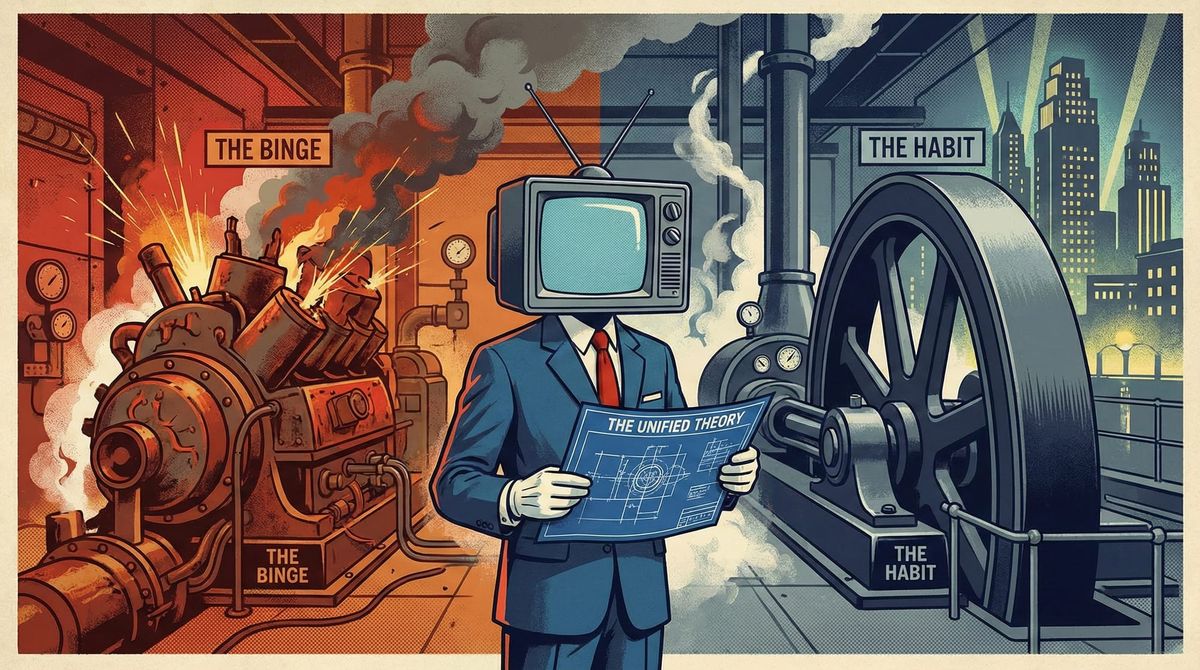
For the last five years, we treated data reports like separate weather updates. Antenna tracked the churn. Luminate tracked the motivation. Parrot tracked the buzz.
Separately, they were just interesting stats. But when you overlay them, they tell a single, undeniable story: Platforms built business models designed to acquire subscribers, but a product experience designed to lose them.
If you are looking at your 2026 roadmap, ignore the noise about "contraction." The industry isn't shrinking; it is correcting a misalignment. Here are the four structural realities that prove why the old playbook failed—and how to fix it.
1. The Value Flip: Why Originals Are No Longer the Engine
Spending big on scripted to accumulate used to be a core tenet of entertainment: If we spend big on an original, the subscribers will come. And this used to work. Think back 10 years to 2016 and how Game of Thrones was running things, the buzz around American Crime Story and the cast including Cuba Gooding Jr. and John Travolta, the glitz and success of The Crown or the start of Stranger Things. Money used to be a strong controlled variable for success.
Then viewers flipped the script.
Luminate’s Entertainment 365 study asked consumers why they signed up for a new SVOD service. “Specific Original Content” was a distant secondary driver for subscriptions (23%), with the dominant reason, at 58%, being “Good Value for Price”.
What drives value? Hub Entertainment Research found that for 60% of consumers, their “new favorite show” isn’t new at all – it’s an older series like Suits or The Office that they are discovering for the first time.
(This also speaks to the power of platforms that have the scale to surface old hits to new audiences. Netflix in particular has the alchemic ability to transmute an older hit like Dexter (or Suits) and make it relevant enough for reboots to be commissioned. Suits: LA likely died because it was windowed on Peacock after airing on NBC and not Netflix—stranded away from the very audience that resurrected the franchise.
The Executive Reality: With inflation high and subscription fatigue setting in, Library depth is now the retention floor. If you are marketing your service solely on the one new show dropping this month, you’re not building a service; you’re building a turnstile. (Perhaps this is why Apple TV+ is now bundling in MLS games as standard and arguably overpaying for Formula 1). If you don’t have a deep, discoverable library, the viewer churns the moment the credits roll.
Why is the Hub stat so high? It’s not just nostalgia; it’s anxiety management.
The Stat: Licensed/Library TV shows drive nearly 2x the viewership minutes of original programming (Nielsen State of Play 2023).
The Science: Academic research on Cognitive Ease (specifically studies by Dr. Jaye Derrick at the University of Houston) found that rewatching familiar shows restores mental energy.
The Mechanism: Because the brain already knows the plot, it doesn’t have to process new information or “fear” the outcome. In a high-stress world, rewatching The Office isn’t laziness—it’s a self-soothing tool to lower cognitive load.
The Insight: Viewers aren’t just buying “entertainment”; they are buying “comfort reliability.”
FASTMaster’s FAST Insight: Channels like Law & Order, The Walking Dead Universe, and BET x Tyler Perry Comedy provide a safe space for viewers. A service just doesn’t need to offer 200 of them.
2. The Hybrid Pivot: How The Binge Debate Was Solved
Unless you are a service with original releases on the scale of Netflix, the math is clear on the “Binge vs. Weekly” debate: weekly all the way.
The industry has learned that while the consumer wants instant gratification, satisfying that desire creates a churn event. Parrot Analytics data shows that binge-released shows burn out faster, sustaining "high demand" for only 52 days on average. Weekly releases, by contrast, sustain it for 68 days—building compound interest in the audience rather than spending it all in one weekend.
Amazon Prime Video figured this out first. Luminate’s analysis of Amazon’s strategy reveals they perfected a "Hybrid Model": dropping 2–3 episodes to generate the acquisition hook (the "mini-binge"), then switching to weekly to extend the billing cycle.
The Executive Reality: You cannot afford to release a hit show all at once. Bingeing is for Acquisition (the hook). Weekly is for Retention (the habit). If you give them everything today, they are gone tomorrow. Unless of course you have a deep library of comfort viewing, or must-see sporting rights.
For years, "weekly vs. binge" was just a theory. Then, researchers from Carnegie Mellon University and UT Dallas proved it with the kind of hard data streamers usually hide. In a massive randomized field trial involving over 60,000 viewers, they tested the "drip" (weekly) vs. "binge" (all-at-once) model on a live platform.
The Result: Viewers who were forced to wait for episodes were 48% more likely to keep their subscription active than those who got the binge drop.
The Mechanism: The "binge" group acted like locusts: they consumed the hit and left. The "drip" group was forced to return to the app repeatedly. That forced return created a "Browsing Effect"—they discovered other shows, built a habit, and by the time the finale aired, they weren't just fans of the show; they were users of the platform.
3. The Consistency Contract: Why Gaps Kill Franchises
The old assumption was that the audience would wait for greatness. The new reality is that the audience has no memory.
Luminate’s analysis of The Bear and season gaps reveals the damage of the "prestige" schedule. Shows that maintain a consistent, annual cadence build momentum. But when a franchise goes dark for too long (18–24 months), that momentum breaks. Luminate found that long gaps don't build anticipation; they build apathy, often resulting in double-digit viewership drops for the returning season.
This feeds directly into the "Serial Churner" crisis identified by Antenna. Their data shows that 38% of subscribers now cancel three or more services in a single year (more specifically, within a 90-day window). They don't "wait" for your show to come back; they cancel and resubscribe if they remember.
The Executive Reality: If your franchise takes two years to return, it’s not a franchise—it’s a limited series. You need predictability to fight churn. This means you need bridge content (unscripted spin-offs, FAST channels, podcasts) to keep the IP "warm" during the gap years.
4. The Unreachables: The Audience You Lost
While services debated the logic over release schedules, a huge chunk of the audience simply left.
Deloitte’s Digital Media Trends report dropped a statistic that signals a generational extinction event: 56% of Gen Z consumers say social media content is more relevant to them than traditional TV and movies. They didn't just cut the cord; they never plugged it in.
At the same time, Samsung Ads (using ACR glass-level data) found that linear TV media plans now miss over 80% of the "Streaming-Centric" audience. You cannot reach the modern viewer with a cable buy, and you cannot reach the future viewer with a prestige drama alone.
The Executive Reality: The initial explosion of FAST was driven by cost-conscious audiences, but let's be honest: that audience skews old. It is dominated by library IP (CSI, Law & Order) and local news. It solves for Retention, but it fails at Relevance.
The Proof: The gamble on "Megastar" IP has paid off. MrBeast’s Beast Games became Amazon Prime Video’s most-watched unscripted series ever. Despite production hurdles, Amazon renewed the show for a second and third season, validating that raw viewership potential now outweighs traditional reputational risks.
The Shift: Platforms are no longer treating creators as "YouTube talent" or marketing assets; they are treating them as Tier-One Intellectual Property. Netflix locked The Sidemen for exclusive release, Samsung TV Plus recently launched dedicated channels for Mark Rober and The Try Guys, Roku integrated Good Mythical Morning into its cable-like EPG to fix discovery, and Disney+ launched a "Creators Collection" to keep Lilo & Stitch fans inside their walled garden.
The Reality: If your 2026 roadmap doesn't have a specific strategy to bring Creator IP inside your walled garden, you aren't building a service for the future; you are building a retirement home for the cable bundle. With Gen Z and Alpha spending 90% of their screen time on non-traditional platforms, creators are the only bridge to the next generation of subscribers. Advertisers turning their nose up at this content are missing a "brand-safe" environment with engagement metrics linear TV can no longer provide.
The Bottom Line for 2026
The winners of the next phase won't be the ones with the biggest budgets. They will be the ones who fix the structural flaws of the streaming model.
- Value beats Exclusivity.
- Habit beats Binge.
- Consistency beats Event.
View the Full Presentation
Explore the key charts, industry benchmarks, and the complete "Unified Theory" framework in the slides below.
Need to navigate the broken landscape?
The rules of retention, reach, and relevance have changed. If your brand or advertising strategy needs a clear map of where the media industry is actually going—not just where it’s been—let’s talk.
Contact me directly at gavin@fastmasterconsulting.com