The FAST Audit (Jan ’26): Exclusives, Bloat, and the “Reality” Trap

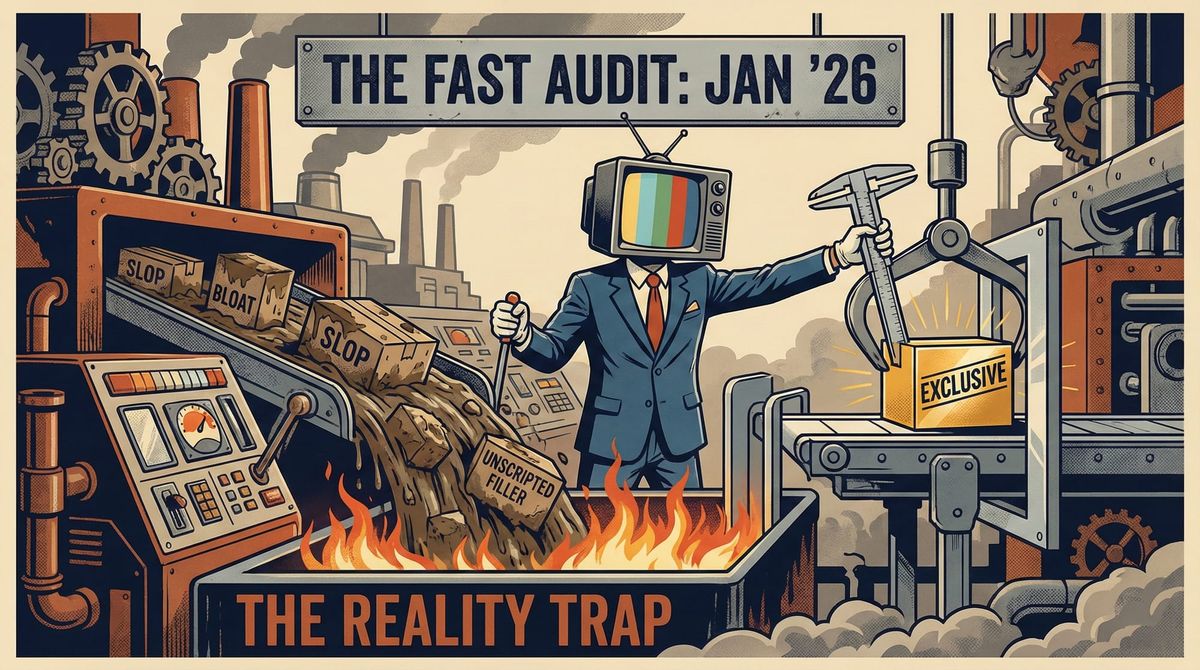
Our monthly tracker of the ecosystem returns. Who is building a distinct platform, and who is just renting the same unscripted slop?
I’ve spent the last week rebuilding my old FAST channel tracker database, adding in greater genre consistency, some new analysis (18-49 brand appeal), and making it as solid as possible for something that remains 100% not scrapped. As the godfather of FAST channel tracking—I think I have a fair claim to having started it, given my records began in late 2019—I may very well look to commoditize this dataset in the near future, especially when combined with some other things I’m working on.
I had to make some hard choices in order to maximize my time and efficiency. Going forward, I will be tracking only the major US FAST platforms that have an estimated reach of 10 million monthly users or more. (If you are not on this list, and have evidence that you should be, I am happy to hear from you). For now, that means the following platforms: LG Channels, Peacock (FAST-channels only, we’ll get to PAST another time), Pluto, Prime Video, Roku Channel, Samsung TV Plus, Tubi, Vizio WatchFree+, and Xumo. Google TV I didn’t include as it appears to no longer cultivate their own line-up but pull from various platforms.
Even a reduced platform list cannot contain FAST. 18 months ago in my final FASTMaster analysis before joining Amazon MGM Studios to head up their FAST channels business, I counted 1,948 channels across a wider ecosystem including Plex, Redbox, STIRR, ViX, Local Now, and Sling FreeStream. Narrowing the list down to just the platforms I tracked this month, the number of unique channels back then was 1,329. That number has grown by 266 channels to a new total of 1,526 for January.
When looking at the distribution of visible channels (i.e., ones that a consumer can see when making a choice), Prime Video offers the most, with over 800. In reality, the total number likely is close to 1,000 as they have many PBS local feeds from all across the country, but these are limited by location on the platform, counter to the local news strategy which shows a viewer every station carried across the country.
In a similar vein, Samsung’s total offering would be at least 100-120 channels greater but they limit the available local news channels to those closest to the user (a more relevant customer experience, perhaps?) by operator, a tactic that LG Channels also employs.
Note how Pluto continues to make use both of its internal available libraries in spinning up exclusive channels as well as licenses content from other areas to include within branded exclusives. By platform, ranked:
· Pluto TV = 31% exclusive channels that can’t be found anywhere else;
· Samsung TV Plus = 28%;
· Prime Video = 24%;
· Roku Channel = 17%;
· LG Channels = 13%;
· Xumo = 11%;
· Vizio WatchFree+ = 8%;
· Tubi = 5%.
Samsung TV Plus and Prime both have market-leading numbers of exclusive unscripted channels (Samsung fed in part by their deal with A&E Networks and their internal curated and ambience-led Vibes channels), Prime Video by deals with WBD, Radial Entertainment, Studio 71 and their internal unscripted channels, many of which were launched or devised under my watch).
But how many of these exclusive channels are must-see? That’s a deep analysis we will dive into soon, but it will be a fair proportion of these exclusive channels. To take the idea of FAST slop further, we are way beyond the era of speculative FAST channels. If you have a content library of note, the best bet is to license it to one of the established big-time packagers (Xumo, Radial Entertainment, Pluto) and have your content be part of a more honed, bigger offering.
Our FAST DNA Radar shows what content types each platform is concentrating on. Most are dominated by unscripted, with bingeable single-IP being a big driver here. As noted last week, a blanket news approach is not very 2026, not only because if you don’t have geo-location abilities in your platform you end up swarming a user with tens if not hundreds of channels they don’t need, but news isn’t youth-skewing. We’ll go deep into local news in FAST in the coming weeks, alongside creators in FAST, what you should do if seeking to launch a new channel in 2026, what my experiences in FAST taught me about the market, and how FAST can salvage itself.
Until then, I'll get back to working on more datasets. Thanks for reading, and in the spirit of content slop, here's a WW1 documentary series I made in 1930s animated stills (you may enjoy):