How the 600-Channel Strategy is Killing FAST Profitability
The race for FAST scale has backfired. Zombie inventory is depressing ad rates and poisoning the ecosystem. With supply outpacing demand, hitting 600 channels isn't growth—it's devaluation. To restore profitability, platforms must embrace scarcity over volume and kill the long-tail bloat.

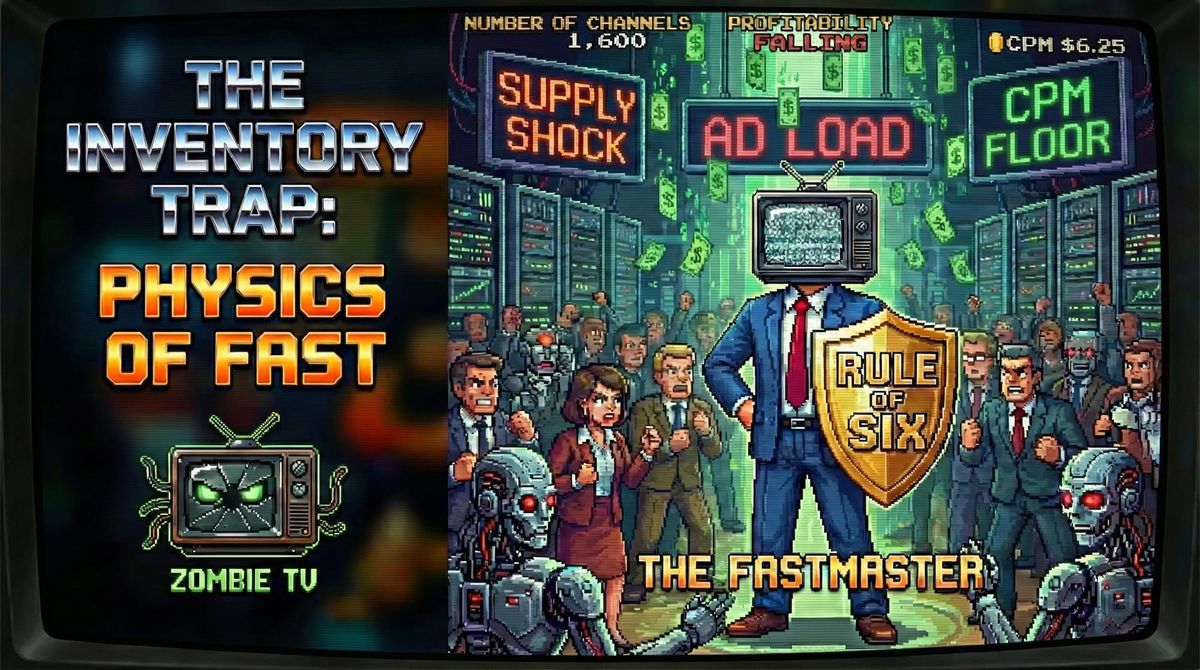
For the last three years, the FAST playbook has been defined by a single metric: Volume. A strategic rethink is in order.
FAST platforms have operated for years on the assumption that adding channels linearly increased revenue somewhat magically (say a 2x-3x channel increase when audience growth was 1.4x), sparking a gold rush to offer the most channels as seen in my FASTMaster monthly tallies. This race for scale has created a surplus of zombie inventory that is not just failing to generate revenue—it is actively depressing ad rates and crushing fill rates across the ecosystem. We have hit the point of diminishing returns.
The Supply Shock
While Connected TV (CTV) ad spend is undeniably healthy—projected to reach over $33 billion in 2025—the volume of available ad slots has grown at a far more aggressive rate. As major SVODs introduce ad tiers and FAST platforms expand their EPGs, inventory supply has outpaced advertiser demand. The result is a classic buyer’s market: pricing power erodes as advertisers find themselves flush with options.
The Physics of Devaluation: The Ad Load Equation
To understand why revenue is stalling despite viewership growth, we must examine the mathematical relationship between Ad Load (quantity) and Effective CPM (price).
I modeled the value of inventory based on 60 minutes of viewing with a target Revenue Per Viewer (RPV) of $0.10. As platforms increase the number of spots per hour, they mathematically dilute the value of each spot:
When a platform pushes into The Red Zone (10 minutes/hour), the Effective CPM falls to $5.00, dropping below the standard programmatic floor of ~$6.00. To fill these 20 slots, the platform is forced to accept bottom-tier ads or fill the gaps with house ads (promos for their own content) which generate zero revenue.
Anatomy of a Zombie (The 777-Viewer Reality)
Why do advertisers refuse to buy the long tail of FAST channels? Because the math reveals they are effectively empty rooms. Let’s break down a channel with 100,000 Monthly Hours—a common size for smaller FAST channels used to pad overall channel counts.
Monthly Hours: 100,000
Average Minute Audience (AMA): 138 Viewers (Nationwide)
Primetime Audience (Peak, assuming ~80% of daily audience): ~777 Viewers
In reality, a channel of this scale is unsellable, even in a bundle. You would reach more people with an ad on a wall in a New York City coffee shop. The rush for platform scale dilutes advertising value and creates zombie channels.
The Scale Gap: FAST vs. Cable
To understand just how small these FAST channels are, we can compare them against a small cable network (50k primetime viewers) and more successful FAST channels (in this example, operating on a single platform).
A hit FAST channel is a viable business. A zombie channel is a rounding error. Flooding an EPG with 50 Zombies does not equal one Hit; it equals 50 fragmentation problems.
How Zombies Poison the FAST Well
The existence of Zombie FAST channels is not just a harmless surplus; it is an active liability that dilutes the value of the entire FAST buy.
The Clutter Tax
By flooding the exchange with low-quality, low-viewership inventory, platforms make it harder for advertisers to find and value the “Hit” channels. When a media buyer sees FAST Inventory, they increasingly associate it with unverified, long-tail filler rather than premium TV.
Campaign Drag
Many advertisers buy “Run of Network” (RON) to get scale. When their ads run across a mix of Hits and Zombies, with Zombies massively outnumbering the Hits, the near-zero performance of the Zombies drags down the overall campaign KPI. The result? The advertiser assumes FAST as a whole is less effective and lowers their bid price for the next campaign.
The Q1 Wipeout
This dilution is most dangerous in Q1. As verified by fill rate data, demand naturally softens in January. For premium channels, this means a dip in revenue. For Zombie Channels, which rely on overflow demand, revenue often evaporates entirely. Yet, the platform still pays the technical costs (CDN, ingestion, EPG management) to keep them alive.
The Bottom Line
A Zombie channel isn’t just earning zero dollars; it is costing the platform money and reputation.
The Only Way Out: The “Rule of Six” (Syndication)
Is there any hope for FAST then? Only through aggregation. FASTMaster modeled what happens when you syndicate these channels across 6 major platforms (e.g., Roku, Pluto, Samsung, Prime Video, etc.).
Zombies remain dead, even at scale. (You just end up with a horde). But Solid FAST channels scale up to rival niche cable networks like MTV2 or Vice TV. Not necessarily enough on their own for a sales team to go out and sell, but valuable as part of a portfolio of offerings.
Hit FAST channels see greater scale and become networks that should be thought of in the same light as buys on the likes of Cooking Channel, Hallmark Family, TV One, and OWN. (The demo of the channel may reduce this slightly - if a Hit FAST channel is one that primarily serves audiences 64+, it falls in value. But scale is a key sales message to note).
The data and analysis proves that the volume strategy for FAST channels is mathematically flawed. To restore pricing power, platforms must pivot to scarcity. This means hard-capping ad loads at 6 minutes per hour and aggressively delisting zombie channels. If a channel cannot sustain a 70% organic fill rate year-round at a $10 CPM floor, it is not a viable business asset—it is merely ghost inventory diluting the value of the entire platform. I wrote in January that ~400 channels was a sustainable goal for a FAST service to offer; now here’s the math to help show why.