Q1 2026 Earnings & Market Review: Bloodbath for the Hype Economy & The Flight to Reality
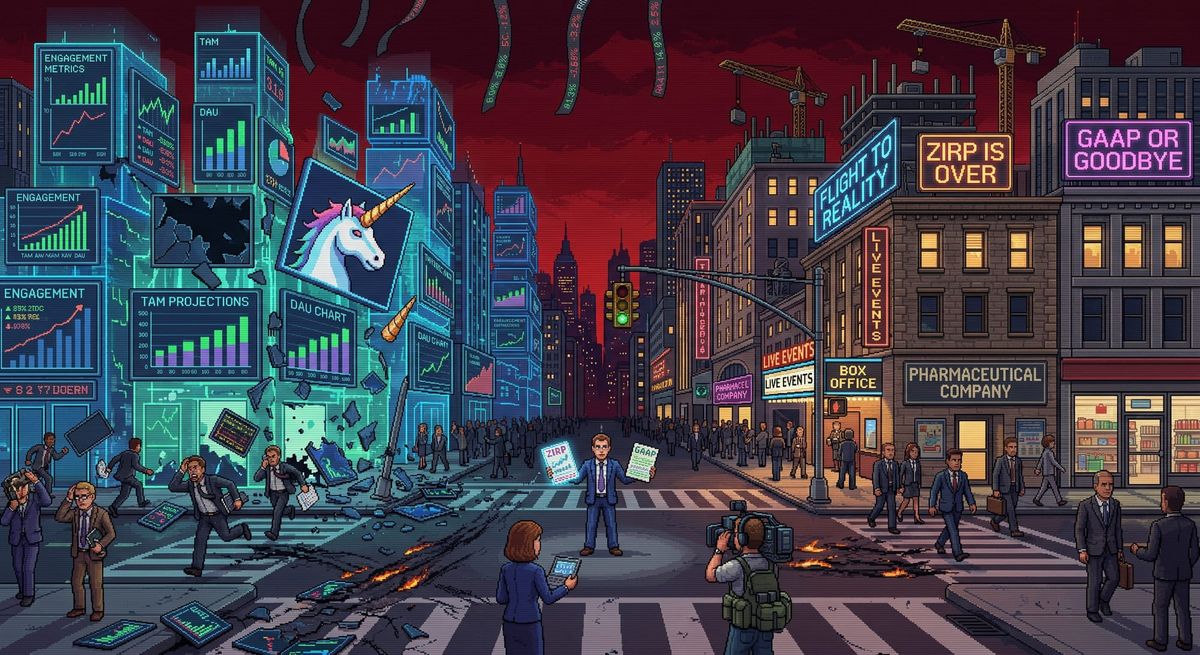
Q1 2026 was a bloodbath for the digital Hype Economy. Wall Street aggressively dumped over-leveraged tech, social media, and sports betting platforms, fleeing to the safety of "IRL" assets, legacy publishing, and physical cash flows. The ZIRP era is dead; market reality is back in session.
The Q1 Bloodbath
If you only glanced at the headline indices at the close of Q1 2026, you might mistake it for a standard, mild macroeconomic correction. The S&P 500 retreated 4.8%, and the Nasdaq 100 slipped 5.7%. But peering beneath the surface of the media, entertainment, and technology sectors reveals a far more violent reality: an absolute bloodbath and a ruthless, structural sector rotation.
Wall Street executed a zero-tolerance policy against the Hype Economy. Institutional capital aggressively dumped zero-interest-rate-phenomenon (ZIRP) business models, speculative total addressable markets (TAMs), and platforms fueled by algorithmic dopamine. Instead, the market initiated a massive Flight to Reality (or the "IRL Premium"). Capital rotated directly into the physical world, heavily rewarding companies with tangible footprints, legacy IP moats, and predictable, physical cash flows. The era of subsidizing digital attention and infinite customer acquisition costs is over. Wall Street is demanding GAAP profitability, constraint, and bottom-line reality.
The "IRL" Premium (Winners)
In an ecosystem plagued by infinite digital abundance and the creeping commoditization of AI-generated content, physical scarcity and tangibility became the ultimate premium assets.
The Live Experience
Sphere Entertainment (SPHR) was the standout, surging +24.5%. Generating $1.1B in trailing revenue (up 8.0% YoY), the Sphere proved it isn't just a Las Vegas novelty—it is a high-margin, un-replicable physical venue boasting absolute pricing power. Cinemark (CNK) defied structural bears, jumping +21.7%. The market isn't pricing theaters for hyper-growth; it is rewarding physical cash-flow resilience ($0.13B in positive EBITDA) against a manageable $1.88B debt load. Live Nation (LYV) followed suit, leaping +18.7% as consumer spend prioritized out-of-home spectacles over digital subscriptions.
Legacy Publishing’s Renaissance
The most unsexy sectors delivered some of the highest returns. Scholastic (SCHL) rocketed +31.1%, John Wiley & Sons (WLY) climbed +24.7%, and The New York Times (NYT) surged +19.9%. In an internet increasingly flooded by algorithmic noise, authoritative, legacy-branded text and proprietary institutional subscriptions are acting as highly defensive safe-haven assets.
The Hype Hangover (Losers)
For companies trading on digital engagement and pure-play consumer tech, Q1 was an execution.
The Sports Betting Collapse
The narrative of infinite, state-by-state TAM expansion hit a brick wall. DraftKings (DKNG) plummeted -39.4%, Flutter Entertainment (FLUT) bled out -53.9%, and pure-play data provider Genius Sports (GENI) cratered -58.9%. The DraftKings drop was particularly brutal: despite posting +42.8% YoY revenue growth in Q4 2025, the stock tanked after management issued deeply conservative FY2026 revenue guidance ($6.5B–$6.9B vs. $7.3B expected). The underlying engine is sputtering—DraftKings reported flat Monthly Unique Payers, signaling severe market saturation. Meanwhile, Flutter was kneecapped by a perfect storm of regulatory headwinds, citing "swift, disciplined responses" to sudden legislative changes in India that banned real-money gaming, alongside punishing new U.K. gaming taxes and an out-of-sync promotional strategy that drove up customer churn.+2
Social Media & Pure-Play Digital
Snap Inc. (SNAP) and Reddit (RDDT) were decimated, dropping -43.4%and -41.9%, respectively. Digital ad dollars are finite, and the market simply refuses to underwrite the user acquisition and infrastructure costs of mid-tier social networks in a tightened economy.
Deep Focus
There were a few interesting stories catching the eye over the last quarter with stock performance and earnings reports:
The Strategic Burn — Roblox (RBLX)
Roblox stock fell -30.1%, but its underlying unit economics reveal a deliberate J-Curve. Roblox holds $0.99B in debt against negative EBITDA of -$0.31B, yet it is posting a staggering +43.0% YoY revenue growth with $4.9B in TTM revenue. Q4 2025 earnings confirmed incredible platform velocity, with Daily Active Users (DAUs) growing 69% YoY. Management is actively choosing to burn cash to fund massive developer payouts and global infrastructure, explicitly stating they expect to remain unprofitable for the next three years as they look to build an insurmountable scale advantage. It is a textbook Strategic Burn to win the interactive future, but the unforgiving Q1 market punished them anyway for lacking immediate profitability.+1
The Death Spiral — AMC Networks (AMCX)
Down -26.6%, AMC is the poster child for legacy media decay. Carrying $1.7B in debt, printing negative EBITDA (-$0.05B), and suffering a revenue contraction (-0.7% YoY), its leverage is Infinite and its business is fundamentally broken. During their recent Q4 earnings, management celebrated that streaming revenue grew 14% and is now their "largest domestic revenue component." They stated a plan of "disciplined approach to content curation and cost control." But this is a pyrrhic victory; niche streaming growth simply cannot plug the massive revenue hole left by the dying linear cable bundle. You cannot cut your way to growth.
The Death Spiral — Ubisoft (UBI.PA)
The French AAA publisher is in absolute freefall, down -41.7%. With an 18.3% revenue contraction, -$0.18B in negative EBITDA, and $2.35B in debt, the company is suffocating. Management's recent Q4/Q1 restructuring announcements are a panic button: they are closing studios in Halifax and Stockholm, taking a massive €650 million write-down, and canceling six games outright. They plan to slash €500 million in costs and are projecting a catastrophic €1 billion operating loss for the fiscal year just to survive their debt load.
The Zombie Anomaly — EchoStar / Dish (SATS)
EchoStar’s operating metrics are apocalyptic: an $18.7B debt load, -$0.57B in EBITDA, and a 5.0% revenue contraction. Yet, the stock inexplicably ticked up +6.4% in Q1. Why? Because management managed to stave off imminent bankruptcy by securing a Restructuring Support Agreement (RSA) with 82% of noteholders, prepaying $1.6 billion in high-cost debt.Furthermore, they took a massive $16 billion impairment charge to officially abandon their 5G network buildout, pivoting to a strategic satellite partnership with SpaceX. Wall Street is no longer valuing the rotting pay-TV business; SATS is trading entirely as a distressed spectrum-salvage operation and financial engineering proxy.
Big Tech's Reality Check
Finally, the trillion-dollar apex predators were not immune. Big Tech carried the broader indices lower as the market aggressively compressed their multiples, demanding proof of immediate software ROI for their gargantuan AI capital expenditures. Enterprise and cloud giants took severe haircuts: Salesforce (CRM) tumbled -29.7%, Oracle (ORCL) fell -25.1%, and Microsoft (MSFT) shed -21.6%. Even hardware monopoly Apple (AAPL)dropped -6.4%, and NVIDIA (NVDA) dipped -7.6% despite posting eye-watering 73.0% YoY revenue growth.
The narrative for the remainder of 2026 is brutally clear: The era of blindly financing digital TAMs is over. Show us the physical moat, show us the cash flow, or prepare to be liquidated.
Longtime readers may recall that I was the driving force behind the series of reports on Variety VIP+ that were market previews for companies in the entertainment industry. While I am not bringing back that level of reporting, I intend to cover the earnings reports of key companies going forward, with easy to digest summaries for each company. Sectors I intend to cover in detail:
Ad-Tech & Infrastructure: Alphabet, Amagi, AppLovin, Comscore, DoubleVerify, IAC, Magnite, Meta, PubMatic, The Trade Desk.
AI & Cloud: Alphabet, Amazon, AMD, IBM, Meta, Microsoft, NVIDIA, Oracle, Palantir, Salesforce, Snowflake
Audio & Live: Apple, iHeartMedia, Live Nation Entertainment, SiriusXM, Sony, Sphere Entertainment, Spotify, Universal Music Group, Warner Music Group
Film & Exhibition: AMC Theatres, Cinemark, Comcast, Disney, IMAX, Lionsgate, Sony, Paramount, Warner Bros. Discovery
Gaming & Interactive: Apple, Electronic Arts, Hasbro, Mattel, Microsoft, NetEase, Nintendo, Roblox, Sony, Take-Two Interactive, Tencent, Ubisoft
Linear & Pay TV: Altice USA, AMC Networks, Charter, Comcast, Dish Network, Disney, Fox, FuboTV, Gray Media, NBCUniversal, Nexstar, Paramount, Sinclair, TEGNA, The E.W. Scripps Company, Versant, Warner Bros. Discovery
Publishing & Digital Media: IAC Inc., John Wiley & Sons, News Corp, Scholastic, The New York Times
Social & Short-Form: Bilibili, Kuaishou, Meta, Pinterest, Reddit, Snap, TenCent, YouTube
Video & Streaming: Netflix, Roku, YouTube plus all the legacy media players